
Contents
Covestro, Fraunhofer UMSICHT and Carbon Minds GmbH have launched CARBEX, a research project to recover benzene, toluene, ethylbenzene and xylenes (BTEX) from automotive shredder residue (ASR), a waste stream that is still largely incinerated. According to Covestro’s announcement of 13 November 2026, the aim is a non-fossil carbon source for key polyurethane precursors.
Why ASR matters for polyurethane makers
Covestro uses benzene to make MDI and toluene to make TDI, the building blocks of polyurethanes for insulation foams, vehicle components, car seats and mattresses. Because polyurethane parts from end-of-life vehicles can end up in ASR, CARBEX could help close the loop in automotive recycling. The company says polyurethane accounts for about 20 percent of the stream by weight.
Germany generates more than 466,000 metric tons of ASR a year, of which about 210,000 metric tons go to energy recovery or disposal, Covestro says. Today, aromatics are mainly produced by steam cracking fossil naphtha, which in Germany causes about 8 million metric tons of CO2e in direct process emissions per year, plus about 11 million metric tons from crude oil extraction and naphtha production. Covestro project manager Dr. Stefanie Eiden said the partners are “tapping into a source of carbon that is currently mostly burned”.
Pyromat: pyrolysis with autocatalytic reforming
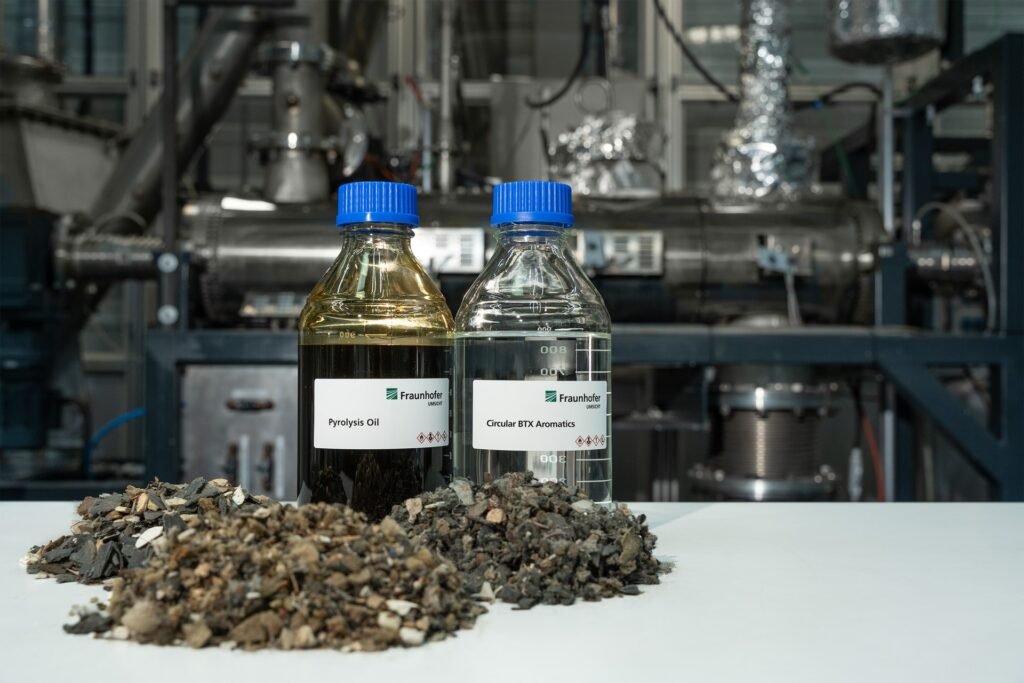
The project uses Fraunhofer UMSICHT’s patented Pyromat process, which combines pyrolysis with autocatalytic reforming and uses pyrolysis coke as both catalyst and adsorbent. At around 500°C, coke components bind halogens such as chlorine and bromine, so no external catalyst is needed. Dr. Thomas Fehn, project manager at Fraunhofer UMSICHT in Sulzbach-Rosenberg, said this makes the process “robust and cost-effective, especially when dealing with highly contaminated waste streams”.
In preliminary lab-scale tests on ASR, the pyrolysis oil reached 62 percent BTEX by weight, about 60 percent more than conventional pyrolysis oils, while halogen content fell by up to 99 percent. Process emissions are estimated at about 1.1 metric tons of CO2e per metric ton of BTEX, compared with 1.6–1.8 for steam cracking.
Pilot plant by 2028
CARBEX runs from September 2026 to August 2029 and is funded by Germany’s Federal Ministry of Research, Technology and Space under the KlimPro-Industrie II programme. Next, the process will be scaled up to continuous pilot operation at 10 kg per hour: Fraunhofer will convert a fixed-bed reactor into a moving-bed reactor, targeting at least 50 kg of BTEX-rich oil with halogens below 30 ppm. Continuous pilot-scale operation is planned by 2028.
Covestro will develop a distillation-based separation of benzene and toluene, test them in MDI and TDI production and carry out a techno-economic assessment, while Carbon Minds will perform an ISO-compliant cradle-to-gate life cycle assessment. According to industry analyses, Germany produces more than 2.6 million metric tons of aromatics a year, worth about EUR 1.95 billion; market studies cited by Covestro suggest widespread adoption could cut up to 640,000 metric tons of CO2e a year in Germany. Covestro adds that CARBEX could help meet the recycled-content targets for vehicle plastics under the EU End-of-Life Vehicles Regulation (ELVR), which start in 2032.
Sources
- Covestro, “Covestro and Fraunhofer UMSICHT turn end-of-life vehicle waste into basic chemicals”, press release, 13.11.2026 – covestro.com
Image: Covestro

Author