
Contents
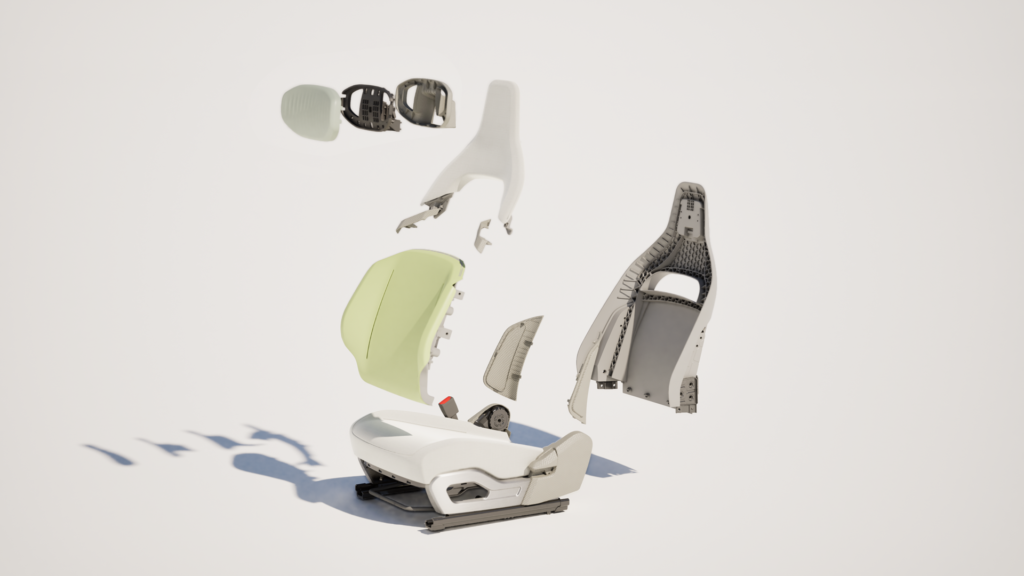
Engineering plastics, polyurethanes and thermoplastic polyurethane (TPU) from BASF form the material basis of a concept seat co-created with Hyundai Motor Company-Kia and Alten Korea for the Kia EV3 Study Car 2.0. Announced in Seoul on 9 November 2026, the seat combines circular material approaches with design-for-disassembly principles, with the materials integrated into the seat architecture to make dismantling and material separation easier at end of life.
Which material goes where
- Headrest: Elastollan® TPU made partly from bio-based feedstock and foamed with Whistling® supercritical foaming technology, patented by Comtech Chemical of Korea.
- Seat cushion and backrest: Elastoflex® W flexible polyurethane foam containing post-consumer recycled content.
- Upholstery: Haptex® polyurethane synthetic leather with bio-circular feedstock.
- Seat back cover: Ultramid® CR RC4 polyamide (PA) containing post-consumer recycled content.
According to BASF, the metal seat back frame can also be replaced with Ultramid for an integrated structure incorporating the back cover.
Interfaces between PA, PU and TPU
Alten Korea developed the seat design together with Hyundai Motor Company-Kia and BASF, integrating the partners’ material and disassembly goals. “A seat is a tightly integrated system, so changing how its components are separated also affects its structure, assembly and appearance,” said Gwanghyun Kim, Executive Director at Alten Korea.
“Automotive seats require different material classes to work together within a single system,” said Andy Postlethwaite, Senior Vice President, BASF Performance Materials Asia Pacific, explaining that the collaboration examines the interfaces between PA, PU and TPU. “Study Car 2.0 gives us a practical environment in which to examine end-of-life considerations during vehicle and component development,” said Jongkook Lee, Vice President, Hyundai Motor Group. He added that the project helps the partners assess how material selection, assembly methods and future dismantling requirements interact.
Building on earlier joint concepts
Hyundai Motor Group and BASF have previously worked together on the Hyundai i-flow (2010), Hyundai RN30 (2016) and Kia EV3 Study Car (2024) concepts. Based on the Kia EV3 platform, Study Car 2.0 extends end-of-life design to more vehicle materials and to the seat.
Sources
- BASF, “Hyundai Motor Company-Kia, Alten Korea and BASF co-create concept car seat in Kia’s new EV3 Study Car 2.0”, P-26-190, 09.11.2026 — https://www.basf.com/global/en/media/news-releases/2026/11/p-26-190
Image: BASF

Author