
Contents
Türkiye’s deposit return system for beverage packaging, DOA (Depozitosu Olan Ambalajlar), was presented to international participants at a panel organised by the Türkiye Environment Agency during COP31. Since national roll-out began on 1 July 2026, the system has grown from 150,000 to 4 million users, and its return points have risen from 1,700 to about 7,500.
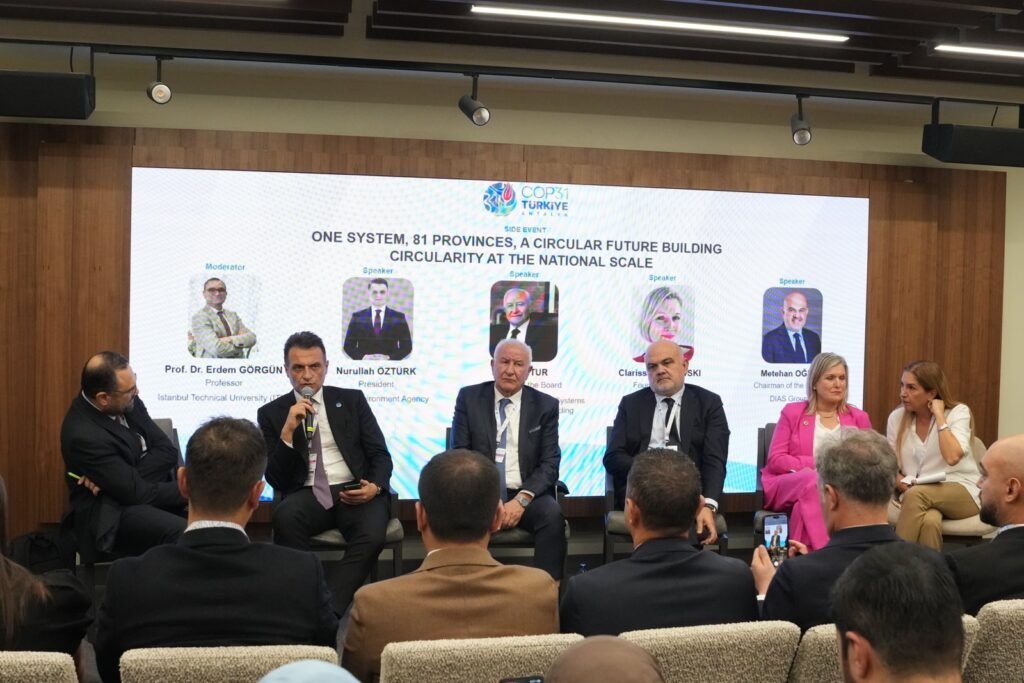
The panel, titled “One System, 81 Provinces, a Circular Future: Building Circularity at National Scale”, took place on 11 November 2026 at the Türkiye Pavilion in the COP31 Blue Zone in Antalya. Moderated by Prof. Dr. Erdem Görgün, it brought together Türkiye Environment Agency President Nurullah Öztürk, DİAS Teknoloji Chairman Metehan Oğuz, TOBB Waste and Recycling Industry Assembly Chairman Ali Kantur and Reloop Platform CEO and founder Clarissa Morawski. DOA currently operates in all 81 provinces and 973 districts through around 5,000 manual return points and 2,500 reverse vending machines.
Target of 50,000 return points within two years
Öztürk said infrastructure is being planned around local needs because population and consumption density differ by region, and that the agency aims to reach at least 50,000 return points over the next two years: roughly 40,000 manual return points and 10,000 reverse vending machines. According to Öztürk, about 100 counting and verification centres with 155 lines are currently in operation, and the plan is to raise this to 140-150 centres and 600 lines by the end of 2027.
One digital backbone, producers from 12 countries
Metehan Oğuz of DİAS Teknoloji pointed to Denmark, which reached a 96 percent return rate and a collection volume of 2.2 billion containers a year over 20 years, and noted that about 25 billion deposit-bearing containers are placed on the market in Türkiye each year. He said the system runs on a single digital backbone that also includes producers in 12 countries supplying packaging and beverages to Türkiye, with secure marking and digital checks allowing containers to be tracked from market entry to return and recycling. The system is open to different manufacturers, field operators and recyclers, Oğuz added.
Bringing informal collection back into the system
Ali Kantur cited facilities in Mamak, Sincan and Adana, noting that the integrated plant in Sincan receives about 6,000 tonnes of waste a day. He said a significant share of the material that should reach such plants has over time been diverted into informal collection, reducing volumes and making traceability harder, and that the deposit system, along with other materials to be covered later, will let the sector plan its operations around predictable collected volumes.
Collection rates in Europe close to 90 percent
Clarissa Morawski said producers have recognised the importance of reliable access to clean, high-quality recycled PET, that collection performance in Europe is approaching 90 percent and that some schemes have cut littered beverage containers by up to 75 percent in their first year. According to Morawski, 24 new deposit systems have been launched worldwide over the past decade, around 415 million people in 63 countries and regions have access to such systems, and the total is expected to reach 73 by 2029.
Closing the panel, Öztürk said DOA’s software and technology infrastructure was developed with contributions from local engineers and manufacturers, and that as the system matures Türkiye could find significant opportunities in the international market for deposit technologies.
Sources
- Türkiye Environment Agency press release, “4 milyon kullanıcıya ulaşan DOA sistemi COP31’de dünya sahnesine çıktı”, 12 November 2026 (via Pupa İletişim and Faselis)
Image: Türkiye Environment Agency

Author